Marissa Henley

Encouraging weary women to hope in Christ alone

  • Books
    • After Cancer
    • Loving Your Friend Through Cancer
  • Speaking
  • Blog
    • Videos
    • Guest appearances
    • No Matter What Monday
    • Cancer
    • Family
    • Faith
  • Free Ebook
  • About

A Biblical Gospel – Radical, chapter 2

September 21, 2010 by Marissa 5 Comments

Click here and scroll down to read my other posts on David Platt’s book, Radical.

Are you believing the gospel as it is described in God’s Word, or are you believing an Americanized version?  This is the poignant question posed to readers in chapter two of Radical. Many of us have bought into a watered-down, Americanized false gospel, and therefore, we have a watered-down, Americanized response to Christ’s call to discipleship.

When my grandpa was in seminary, he was asked to write a paper on the chief attribute of God.  He wrote a wonderful essay on God’s love.  And he received a big fat F.  Grandpa wouldn’t mind my sharing this story–he loved to tell it–to illustrate the trap that so many Christians fall into.  Is God loving?  Absolutely.  There are countless verses in Scripture where God tells us how much He loves His people.  The problem comes when we stop at God’s love without looking at the whole of what Scripture says about God.  God’s Word tells us that He is the sovereign Creator, the Holy Judge who must deal justly with sin.  My grandpa’s seminary professor said that God’s chief attribute is His holiness–His purity and righteousness that makes Him God and us not God.  Are we willing to give as much weight to John 3:36 as we do to John 3:16?

As Platt writes, “The gospel reveals eternal realities about God that we would sometimes rather not face.  We prefer to sit back, enjoy our cliches, and picture God as a Father who might help us, all the while ignoring God as Judge who might damn us . . . We are afraid that if we stop and really look at God in his Word, we might discover that he evokes greater awe and demands deeper worship than we are ready to give him” (p. 29).

Platt asserts that we must also face what the biblical gospel says about who we are in relation to God.  Here’s a pop quiz:

True or false?

1.  “God loves you and has a wonderful plan for your life.  Therefore, follow these steps, and you can be saved.” (Radical, p. 32)

2.  “You are an enemy of God, dead in your sin, and in your present state of rebellion, you are not even able to see that you need life, much less to cause yourself to come to life.  Therefore, you are radically dependent on God to do something in your life that you could never do.”  (Radical, p. 32)

The first is what is being proclaimed in many churches all over this country.  It leads to complacency, entitlement, and the expectation that God will fix all my problems and make me happy.

The second is what God’s Word says about our human condition.  It leads to wholehearted devotion of our entire life to a God who came to us, to redeem us from the pit of our sin and make us righteous in His sight.  It causes overflowing gratitude and commitment to our Creator who poured out the wrath we deserve on His sinless Son.  In Platt’s words, “Surely this gospel evokes unconditional surrender of all that we are and all that we have to all that he is” (p. 37).

Which gospel are you believing?  And how will you respond?

Share

Prayer Binder: Adoration

September 15, 2010 by Marissa 2 Comments


For the introduction to my prayer binder, click here.

Ever since I learned the Adoration-Confession-Thanksgiving-Supplication prayer tool many, many years ago, I’ve known it was a good idea to praise God for who He is before presenting my laundry list of needs.  But to be honest, this was the most awkward aspect of prayer for me for a long time.  I’d usually throw out my usual, “Lord, you are holy, you are good, you are loving,” and then move on.

Last summer, I studied God’s character and attributes with a wonderful group of ladies–I highly recommend the study, Behold Your God.  It was very helpful to study God’s omniscience, omnipotence, faithfulness, sovereignty, immutability, and more . . . basically, a study of what God has told us about Himself and what it means for our lives.  And one fabulous by-product of this study is that I was armed with Scripture about the Lord that I can use to praise Him for His character.

In the Adoration section of my prayer binder, I write attributes of God with Scripture listed underneath.

I’m constantly adding to this list, and the added Scripture breathes new life into this part of my prayer life.  As I read God’s Word, I’m watching for new verses to add to my Adoration section.  If you’re interested in starting an Adoration section in your prayer journal, here are some verses to get you started:

God’s love:  Jeremiah 31:3, Psalm 106:1

God’s wisdom:  Psalm 32:8, Isaiah 55:8-9

God’s power and strength:  Job 9:4-9, Psalm 46:1-3

What are your favorite Scripture that speak of the character of God and lead to worship of Him?

O magnify the Lord with me; let us exalt His name together!  Psalm 34:3

Share

My Prayer Binder

September 10, 2010 by Marissa 7 Comments

As I’ve been exploring how to improve my prayer life this year, I’ve developed a prayer binder that has been immensely helpful to me.  I’ve said it before, and it bears repeating:  no system of prayer or prayer tool will produce a vibrant prayer life.  A deeper prayer life will only develop  if you get on your knees and pray.  There have been months when, by the power of the Holy Spirit, I have been disciplined to get my hiney out of bed and USE the prayer binder in actual prayer.  And there have been months when the prayer binder has gone unopened.  It does very little good in that case.  I hope these ideas might encourage you and inspire you to find a system that will facilitate a more vibrant and disciplined prayer life . . . just remember that this is a means, not the end.

In the past, I’ve used a spiral notebook to record prayers, leaving a couple of blank lines below each request to record the answer.  It worked okay, but there were some requests that were answered fairly quickly, and others that were long-term requests.  So I would have to start on page one and flip through the entire notebook to find the “active” prayer requests.  It also did not incorporate the elements of praise, confession and thanksgiving.

So earlier this year, I switched to a prayer binder.

How to develop a prayer binderThose are my goals for 2010 in the front.  Inside, I have a few hymns:

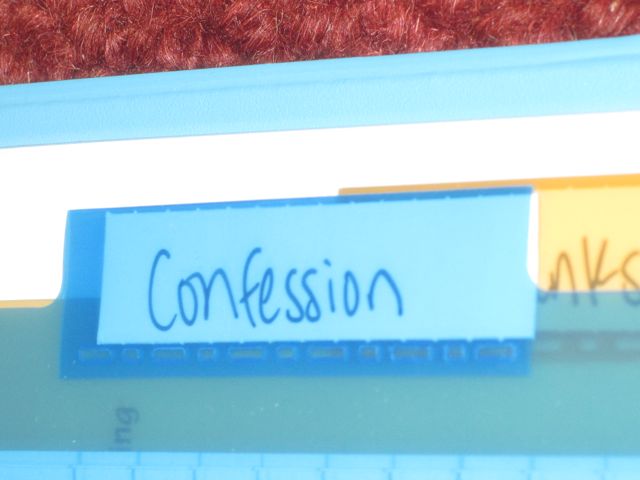
And these nifty tabs – Adoration, Confession, Thanksgiving, and Intercession.

There are 4 tabs in my Intercession section: Ongoing family needs, Ongoing needs of others, Temporary family needs, and Temporary needs of others.

And finally, a section to make notes about prayers or hymns that are meaningful to me in my prayer life.  (Most of these notes come from The Valley of Vision.  And yes, it drives me nuts that I apparently forgot how to spell “hymns” when writing on this tab.)

By the time I’ve gone through the entire binder, God and I have spent a nice bit of time together.  It keeps me focused and on track, rather than offering a rote “Get me through this day, and please keep us healthy” and heading for the shower.

I’m going to address each these sections in their own post.  But I will suggest one small, but important, aspect of my prayer binder to you.  At the front of my intercession section, I have a weekly prayer list.  I developed this list of people to pray for on each day of the week by listing all the individuals and groups I wanted to pray for over the course of the week, and then assigning each one to the day of the week.  I left Sunday open for focused time on the rest of my intercession section, which lists short-term and long-term needs.  Here’s a sample of what a weekly prayer list might look like:

Weekly Prayer ListIf the idea of a whole binder is intimidating, maybe just one list like this could help focus your time with the Lord.  Start big or start small, the important thing is to just do it.  More to come!

Share

The Cost of Non-Discipleship (“Radical,” Ch. 1)

September 3, 2010 by Marissa 3 Comments

In my last post on the book Radical, I shared David Platt’s convicting thoughts about how many Christians ignore what Jesus said about what it really means to follow Him.  Instead, we choose to mold Jesus into a “nice, middle-class, American Jesus . . . who doesn’t mind materialism and who would never call us to give away everything we have” (p. 13).  As convicted as I was by these words, I was even more convicted by Platt’s discussion of the result this misunderstanding of true discipleship.

Platt writes:  “While Christians choose to spend their lives fulfilling the American dream instead of giving their lives to proclaiming the kingdom of God, literally billions in need of the gospel remain in the dark” (p. 14).

While we are busy accumulating stuff and ensuring our comfort, BILLIONS are perishing apart from Christ.  Do we care?  Do I care?  Do I care about the eternal implications for my family member who doesn’t know Christ?  Do I care about the people of Bhutan, a small country between China and India that I read about this morning with my kids, where the government (a Buddhist kingdom) lets very few foreigners inside the country and any Christians who make it in are forbidden to talk about Christ?

If I say I care, do I back it up with actions?  With my checkbook?  With my prayers?

Another large group of people paying the price for our failure to follow Christ properly are the poor.  Platt writes:  “Consider the cost when these Christians gather in churches and choose to spend millions of dollars on nice buildings to drive up to, cushioned chairs to sit in, and endless programs to enjoy for themselves.  Consider the cost for the starving multitudes who sit outside the gate of contemporary Christian affluence” (p. 15).

Platt writes about two headlines he saw in a Christian publication in 2004.  On the cover, the left headline read:  “First Baptist Church Celebrates New $23 Million Building.”  On the right, the headline read:  “Baptist Relief Helps Sudanese Refugees” and the article explained that $5,000 had been raised to help refugees in western Sudan.  Platt concludes:  “Where have we gone wrong?  How did we get to the place where this is actually tolerable?” (emphasis mine, p. 16)

This example makes me crazy.  What are these people thinking?  But then I look at myself.  I don’t have $23 million to spend on myself, but if I did, I’m sure I would.  If I published the amount of money I spend on myself on one side of the front page and the leftovers I give to the poor on the other side, what would my headlines read?  Do my public and private lives honor the Lord Jesus Christ and my commitment to follow Him on His terms?  What is the cost of my non-discipleship in the lives of those around me, both near and far?

These are tough questions, and I encourage you to wrestle through them with me by buying this book and reading it.  In fact, my bloggy friend Marla is hosting a Radical read-a-long, if you’re interested.  I know I can’t wait to hear what others have to say about how God is using this book in their lives.

Share
« Previous Page
Next Page »

Welcome

marissahenley.com

I write to remind myself of the truth of God's promises. I share my writing here in case you need to be reminded sometimes, too.

Let's Connect!

Books

Books

Click the image above to learn more about Marissa's books: After Cancer and Loving Your Friend through Cancer

Recent Posts

  • The Journey After Cancer – CanCare Podcast {Guest Appearance}
  • Guest appearance – Bookish Talks with Lia Podcast
  • Finding Hope Amid Severe Illness {Guest Post for Ligonier Ministries}

Looking For Something?

Copyright © 2026 · Beautiful Pro Theme on Genesis Framework · WordPress · Log in