Marissa Henley

Encouraging weary women to hope in Christ alone

  • Books
    • After Cancer
    • Loving Your Friend Through Cancer
  • Speaking
  • Blog
    • Videos
    • Guest appearances
    • No Matter What Monday
    • Cancer
    • Family
    • Faith
  • Free Ebook
  • About

My Complaining Heart

March 2, 2009 by Marissa 2 Comments

The Israelites are at it again.  Grumbling, that is.  A recurring theme in our BSF study of the Life of Moses this year is how the Israelites continue to grumble and complain in spite of all the wonderful things God has done for them.  Last week, we studied Numbers 11, in which the Israelites once again complain about the manna God is miraculously providing for food each day.  In our lecture, our teaching leader said that we often think we have the right to tell everyone how we are feeling at all times, especially if we are unhappy about something.

She might as well have been talking directly to me.  Even with the sinfulness of complaining being pointed out to me again and again in this study, I still struggle with a complaining heart.  I definitely think everyone around me needs the full story whenever something is bothering me, and there are plenty of things that bother me.  I have to admit, one of the things I look forward to when my husband gets home from work is being able to unload on him all the hardships of my day.  The complaining heart rears its head over and over again.  And Numbers 11 reminds me that each time I complain, I am sinning and even rejecting the Lord and His provision for me (verse 20).

And then there’s the fact that I’m 31 weeks pregnant with my third child.  Those of you who have walked in my shoes know exactly how this could lead to some complaining–complaining that even seems justified until you look at it through God’s holy eyes.  When I first heard the BSF lecture on complaining last week, I thought, “People ask me how I’m feeling all the time.  How am I supposed to answer honestly without complaining?”  Our teaching leader pointed out that God desires our gratitude, regardless of our circumstances.  I need to ask God to take away my complaining heart and replace it with a grateful one.

At first, I just aimed for outward change with regard to complaining.  My husband may not have noticed much change yet–sorry, honey, I’m working on it–but I have tried to answer the “how are you feeling?” questions with less complaining and more thankfulness.   Instead of cataloging every ache and pain for everyone who asks, I try to say I am mostly feeling good and thankful to be having a healthy pregnancy.

As I’ve made this outward change, I’ve noticed that there has been an inward change going on as well.  The aches and pains don’t bother me as much anymore.  They are simply reminders that God has given me the privilege of carrying this baby girl for 31 weeks, and that she is active and growing.

I still have work to do in this area . . . it is hardest to not complain to those I am closest to and other favorite topics of complaining that I need to deal with.  There is a fine line between being honest about my struggles and complaining.  While I want to be open and honest, I also want to glorify God with my speech and not grumble about any of the gifts He has given me–including my kids, my husband, his job, our home, and our finances.

The REAL test will come in 2 months when the baby comes and people ask, “How are you doing?  Are you getting any sleep yet?”  I better start asking God now to show me how to be thankful for sleep that comes in 2 hour increments!

Share

Lessons from Leviticus

February 12, 2009 by Marissa Leave a Comment

Leviticus? Seriously?  I never thought I’d write a blog post about Leviticus.  I should have seen it coming when I started the BSF study of the life of Moses, Exodus through Deuteronomy.  (I suppose there is a post on Numbers coming soon.)  I don’t think I’ve ever studied Leviticus, other than a random reference here and there in other Bible studies.  But as always happens with God’s Word, there are great lessons there.  Here are a few that were especially meaningful to me:

In Leviticus 8, we were studying about the consecration of tabernacle and the priests.  Our lesson asked the question, “Is there some area of your life that has not been consecrated (set apart) to the Lord?”  This question was very convicting to me, and I wanted to write, “Is there an area of my life that HAS been consecrated to the Lord?”  But I tried to narrow down some key areas that have not been dedicated to God like they should and came up with my perceived control over my life and the way I spend my time and money.  I’ve been thinking lately about how I can truly consecrate these areas to the Lord.

In Leviticus 10, we read the troubling story of two of Aaron’s sons being burned up by God because they did not follow the commandments He had given them about sacrifices in the tabernacle.   Our lessons often ask us what we learned about God’s character or attributes from the passage.  This chapter showed me how serious disobedience (sin) is in God’s eyes.  We know from elsewhere in Scripture that our sin is deserving of death, and Aaron’s sons got what they deserved.  It showed me how great God’s mercy to me is–I have not gotten what I deserve.  I have done much worse things than what Aaron’s sons did.  And not only has God not burned me up on the spot, He sent His Son to take the punishment for all my sin that I might have eternal life.

In an overview of Leviticus, we read various passages where God gives the Israelites instructions about how to offer the various sacrifices He required.  The lesson talked about how each of the sacrifices cost the worshiper something.  It pointed to 2 Samuel 24:24, where David says he will not offer something to the Lord that cost him nothing.  This was another convicting point for me.  What have I sacrificed to God at a great cost?  I volunteer in the church nursery once every three months, and that costs me very little.  I am also leading the children’s choir, which carries a greater cost, and most of the time I don’t have a great attitude about that cost.  My financial giving should be more sacrificial–am I truly giving something up that I want in order to give sacrificially, or am I giving what is left over?  Contemplating the true meaning of sacrifice has changed my perspective about my service and giving to the Lord.

I also liked Leviticus 19:9-10 where God commands the Israelites not to harvest their fields all the way to the edges or strip their vineyards bare.  They are to leave some for the poor and for travellers.  This made me think about how I use my resources.  When I know we have some extra money coming, I know we will tithe on it, but I usually have the rest of it spent, at least mentally, before it hits the checking account.  And, apart from this commandment, it would be my right to use it as my husband and I decided.  But in this commandment, God is telling His people not to consume all that they have a right to consume.  I think this principle applies to me as well.  I want to be more intentional about leaving some crops  around the edges in a 21st-century sense . . . stashing some away for needs that arise so we are able to meet the needs of others.

Share

A couple of ideas

January 13, 2009 by Marissa 4 Comments

Occasionally I have a good idea.  It doesn’t happen often.  In fact, I think in the past year, I have had exactly two good ideas.  The second is the reason I’m writing this post, but I’ll share the first as a bonus.

Firstly, I have friends who teach their children the “Interrupting Rule”:  when mom is talking to another adult, either in person or on the phone, and the child has something to say, the child quietly puts his hand on his mom’s arm.  The mom puts her hand on top of his in acknowledgment, and when there is an opportunity, gives the child a chance to speak.  I’ve always admired this rule.  Last fall, I decided to teach it to Christopher.  As I was explaining what I wanted him to do, I had a moment of brilliance . . . I called it our “secret signal.”  There is something intriguing to a 4-year-old boy about having a secret signal, and he caught on right away.  He is terrific at giving me the secret signal!  Sometimes he even gives it to grandparents and other adults who can’t quite figure out why he is standing there with his hand on their arm.  🙂

My recent good idea has to do with praying for my kids.  I have used a couple of different books in the past, and they have been a great help.  My struggle recently has been wanting to spend in-depth time each day praying for my children.  Last summer, I typed out topics and Scripture from Praying the Scriptures for Your Children by Jodie Berndt.  I have used them some, but not as consistently as I’d like.
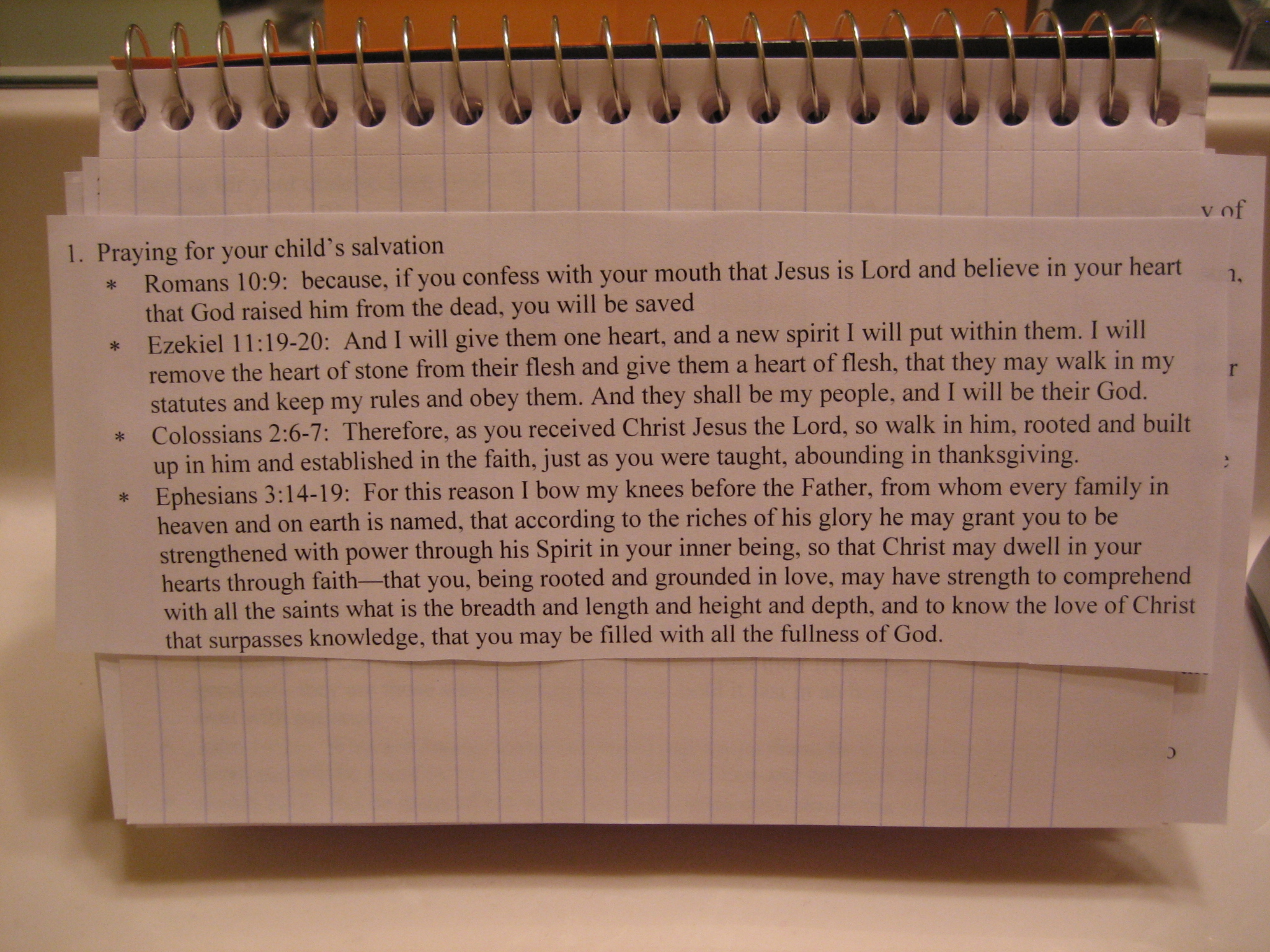
So the other night I cut and pasted the verses into a small notebook, making a flip calendar for myself.  I put it by my bathroom sink, since I spend 10-30 minutes there every morning doing mundane tasks such as brushing my teeth and drying my hair.  I realize this is not as ideal as sitting quietly, devoting myself only to praying these Scriptures for my children, but at least I am reminded of the topic and some verses that I can call to mind during the day.  I also find the verses to be edifying for my personal walk with the Lord each day.  When I’m done with Berndt’s topics, I may cut and paste my notes from
31 Days Of Prayer For My Child
–another great resource about praying for your children.

img_3642

Share

The 10 Commandments and Christmas

December 15, 2008 by Marissa 1 Comment

A few weeks ago, we studied the 10 Commandments in BSF.  Since I have been a Christian for a long time, I am pretty familiar with the 10 Commandments.  I have also studied Jesus’ explanation of some of the commandments in Matthew 5, which points out that these commandments are not just about our external behavior, but also about our heart attitudes.  But this time around, I was even more convicted about different ways in which I break the 10 Commandments, and how meditating on the 10 Commandments at this time of year emphasizes the importance of the work Christ came to do for me.

I would challenge anyone to convince me that they have kept the 10 Commandments.  I’ve certainly broken all of them:  I have put other people and things before God, I have failed to worship God rightly, I have misused His name, I have failed to keep the Sabbath day holy, I have definitely dishonored my father and mother (hello, adolescence!–and beyond), I have hated others, lusted, taken what does not belong to me, lied, and coveted.  Even if you set aside Jesus’ discussion of some of these commandments and take them all purely at face value (e.g., believing that if you have not murdered someone or bowed down to a golden idol, you have not broken those 2 commandments), you have admit–that 10th commandment about not coveting anything that belongs to your neighbor has got you, doesn’t it?

I have heard some Christians say that the 10 Commandments do not apply to us.  They are from the Old Testament, the old covenant–now we are under grace, not under the law.  I disagree.  Jesus said, ““Do not think that I have come to abolish the Law or the Prophets; I have not come to abolish them but to fulfill them” (Matthew 5:17).  And so if God requires us to keep the 10 Commandments, and if we all have to admit we haven’t done it, then we have a problem.

However, God, in His goodness and grace, not only gives us His law, but He is the one to remedy the situation when we fail to keep it.  God became man and dwelt among us, not only to teach us and heal us, but to live the perfect life that we could not live.  We cannot keep these commandments; Jesus Christ kept them perfectly, and He bore the punishment for our law-breaking on our behalf.  This truth gives us just one more reason to rejoice this Christmas!  Christ came to die for us, and He also came to live for us, to keep the law perfectly for us.

I think this is also an important point to teach our children.  When they sin, we can remind them of the One who was without sin.  Jesus obeyed His parents perfectly.  Jesus did not sin in His anger.  (I wish the Bible told us that Jesus ate his peas, it would really help me out!)  His perfection qualified Him to pay the penalty for our children’s disobedience, and it is important for them to understand that.  The baby Jesus was born to die for them, and also to live for them.  Their obedience should not be motivated by Santa’s list or by an elf on the shelf (no offense to those of you with elves on your shelves), but by gratitude to God for what He has done for us in Christ Jesus.  O come let us adore Him!


Share
« Previous Page
Next Page »

Welcome

marissahenley.com

I write to remind myself of the truth of God's promises. I share my writing here in case you need to be reminded sometimes, too.

Let's Connect!

Books

Books

Click the image above to learn more about Marissa's books: After Cancer and Loving Your Friend through Cancer

Recent Posts

  • Guest appearance – Bookish Talks with Lia Podcast
  • Finding Hope Amid Severe Illness {Guest Post for Ligonier Ministries}
  • God’s Faithfulness in a Winter Season – Part 3 {Guest post for enCourage}

Looking For Something?

Copyright © 2026 · Beautiful Pro Theme on Genesis Framework · WordPress · Log in